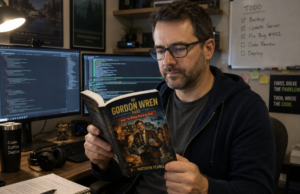
IT consultants spend their working lives entering situations that are already more complicated than anyone admitted during the first meeting. A client describes a minor software problem, then reveals three incompatible databases, an undocumented server, an ancient accounting program and a former employee who apparently took every password with him. Success depends on technical knowledge, but it also requires patience, observation, diplomacy and the ability to notice when the official explanation does not match what is happening.
That is precisely why The Gordon Wren Files: Book 1: The Wrong Man at the Door deserves a place on an IT consultant’s reading list. Gordon Wren is not a trained intelligence officer, international assassin or polished action hero. He is a middle-aged kitchen-appliance salesman who arrives to do his job and gets mistaken for someone far more dangerous. Before long, he is caught in a conspiracy involving an international summit, a compromised hotel, suspicious service traffic and criminal activity hidden behind ordinary commercial equipment.
This unusual British spy thriller series turns practical competence into an unexpected advantage. Gordon succeeds because he understands how objects should be packaged, how deliveries should move, how service areas normally operate and how people behave when they are carrying something important. Those abilities may not look glamorous, but they will feel remarkably familiar to anyone who has ever been called into a business to discover why nothing works properly.
Gordon Wren Thinks Like an IT Consultant 🖥️
According to Wikipedia’s overview of information technology consulting, IT consultants help organizations use technology to support their business objectives. That description sounds straightforward until a consultant enters the organization and discovers that the stated objective, the available technology and the way employees actually work have almost nothing in common.
Gordon faces a similar divide between official appearances and operational reality. A luxury hotel may look organized from the lobby, but service corridors, loading areas, storage rooms and delivery schedules reveal how the building truly functions. He notices details that trained professionals overlook because they are searching for evidence that looks like espionage. Gordon looks for things that look wrong.
An IT consultant may recognize a security concern because an employee has access to a system that has nothing to do with that employee’s role. A network diagram may appear reasonable until it is compared with the physical equipment. A vendor may insist that an integration is working while users quietly maintain a spreadsheet because the integration has never worked correctly.
This is the central connection between Gordon’s predicament and consulting work. Both involve walking into unfamiliar environments, separating assumptions from evidence and identifying the small operational inconsistency that explains the larger failure. Gordon does not need to behave like a cinematic spy. He needs to remain observant while everyone else is distracted by their own theories.
The Story Understands the Value of Overlooked Knowledge 🔍
The official description of The Wrong Man at the Door explains that Gordon has spent years being ignored in wealthy homes, loading bays, hotel corridors and poorly managed demonstration environments. That experience gives him a detailed understanding of places that powerful people rarely notice. He knows how equipment should be carried, where deliveries should go and when a route makes no practical sense.
IT consultants frequently build the same kind of knowledge. They learn that a receptionist may understand a company’s customer-management system better than the executive who purchased it. They discover that the quiet employee in accounting knows which reports are inaccurate and why. They recognize that the person who resets the router every Tuesday may hold more useful information than a month of automated monitoring.
A detailed CIO overview of the IT consulting profession describes consultants as professionals who assess technology, advise clients and connect technical decisions with business goals. It also emphasizes the importance of understanding the client’s broader situation rather than concentrating on one isolated system.
Gordon’s strength comes from exactly that kind of contextual awareness. He does not merely see a box, a corridor or a piece of equipment. He sees how it fits into the surrounding operation. He recognizes the expected pattern, which allows him to identify the exception. For consultants, that ability is often more valuable than memorizing another list of product features.
It Is a Spy Story About Process Failure ⚙️
Many technology disasters begin with a process that almost works. An employee skips one approval step because it saves time. A temporary workaround becomes permanent. A shared account remains active because no one wants to interrupt operations. Documentation is postponed until after launch and then quietly forgotten.
The villains and intelligence professionals surrounding Gordon operate inside more dramatic systems, but they face the same fundamental problem. Their plans depend on people, procedures, timing and assumptions. Once one part of the process behaves differently than expected, the entire operation begins to unravel.
The National Institute of Standards and Technology guidance on information and communications technology risk emphasizes that technology risks should be understood within an organization’s larger mission and enterprise risk program. A technical problem is rarely confined to one device or department. It can affect operations, finances, customer relationships, legal responsibilities and strategic goals.
The Wrong Man at the Door turns that principle into entertainment. An ordinary salesman interferes with a sophisticated conspiracy because the people running it fail to account for someone who understands ordinary business operations. Their plans are technically clever but operationally fragile.
An IT consultant will appreciate the irony. Complex systems are often defeated by simple realities. The expensive platform cannot complete its automated workflow because someone entered a customer name differently. The new security policy fails because nobody explained it to the staff. The elaborate criminal plan begins collapsing because Gordon Wren knows how kitchen equipment is supposed to be delivered.
Gordon Demonstrates Practical Risk Awareness 🛡️
Consultants working with small businesses often encounter owners who assume cybersecurity threats only affect banks, governments and multinational corporations. The reality is less reassuring. The Cybersecurity and Infrastructure Security Agency’s guidance for small businesses organizes cybersecurity around the ways attacks actually occur and encourages leaders to treat protection as an operational responsibility rather than an isolated technical task.
Gordon’s awareness works in much the same way. He does not evaluate danger through dramatic labels. He studies behavior. A route that makes no sense deserves attention. Packaging that does not match its contents deserves attention. A person holding an ordinary object as though it matters more than anything else deserves attention.
This is an excellent mindset for consultants. A suspicious login, unusual data transfer or unexplained administrator account may not prove anything by itself. It is the deviation from normal activity that creates concern. Consultants must understand the normal environment before they can recognize the meaningful anomaly.
Gordon’s observations also demonstrate why practical experience cannot be replaced entirely by automated tools. Software can record activity and generate alerts, but someone still has to decide whether the activity makes sense. A consultant who understands the client’s people, workflow and business model can interpret signals that would otherwise remain disconnected pieces of information.
The Humor Will Feel Familiar to Anyone Who Has Met a Difficult Client 😄
IT consulting produces its own form of absurdity. A company delays replacing a failing server because the replacement is considered expensive, then spends more money responding to repeated outages. A client requests stronger security but refuses multifactor authentication because it requires an extra step. An executive demands immediate digital transformation while remaining emotionally attached to a spreadsheet created in 2004.
The humor in The Gordon Wren Files grows from that same collision between competence and institutional foolishness. Gordon is surrounded by people who interpret his practical reactions as evidence of advanced training. The more ordinary his explanation, the more mysterious he appears. Professionals assume he must be improvising an elaborate strategy when he is often trying to prevent someone from mishandling expensive equipment.
The result is not a parody that abandons suspense. The official book description presents the novel as a fast, funny spy thriller driven by sharp dialogue, escalating absurdity and a hero armed with competent annoyance. The danger matters, but so do the ridiculous decisions that allow it to grow.
For consultants accustomed to translating technical problems into polite language, Gordon’s frustration will be especially recognizable. He sees the problem clearly. Everyone else insists on making it more complicated. His annoyance becomes productive because he continues paying attention even when the people around him are committed to misunderstanding the situation.
The Book Reinforces the Importance of Clear Communication 📣
Technical skill alone does not make an effective consultant. A brilliant recommendation has little value when nobody understands it, supports it or knows how to implement it. Consultants must communicate with executives, employees, vendors, technical teams and people who have already decided that the new system is personally responsible for ruining their week.
The Project Management Institute’s guidance on communication describes effective communication as a foundation of business and project success. Communication helps teams understand their purpose, helps decision-makers evaluate priorities and helps organizations maintain support for important work.
Gordon’s experience shows what happens when communication breaks down completely. People make assumptions about his identity, abilities and intentions, then interpret his words through those assumptions. His straightforward statements acquire unintended meanings. Every attempt to clarify the situation risks making him appear even more capable and secretive.
The exaggeration is funny, but the underlying principle is serious. Once people create a narrative, new information is often forced into it. Consultants see this when a client decides that every problem is caused by the network, the software vendor or one unpopular employee. Clear communication requires more than presenting facts. It requires recognizing the assumptions through which those facts will be interpreted.
It Encourages Consultants to Look Beyond the Dashboard 📊
Modern consulting depends on monitoring platforms, analytics, reports and automated alerts. These tools are valuable, but they can create false confidence when the data is incomplete or the measurements are disconnected from business reality.
A dashboard may show that every system is online while employees remain unable to complete basic work. A project report may display green status indicators while team members quietly prepare for failure. A vendor may meet every service-level target while customers continue experiencing unacceptable problems.
Reporting on research concerning successful IT initiatives, TechRepublic has highlighted the importance of connecting technology investments with business outcomes. Technology projects do not succeed merely because a platform was installed. They succeed when people can use the result and the organization receives meaningful value.
Gordon operates without a digital dashboard, but his instincts reflect the same lesson. He pays attention to the physical and human evidence in front of him. He notices how people move, how objects are handled and whether the visible activity matches its supposed purpose.
IT consultants who develop that habit become more effective advisors. They spend time with the people using the system. They observe the workflow instead of relying entirely on its documentation. They ask employees to demonstrate what they actually do rather than describe what they are expected to do. The gap between those two versions often contains the real problem.
Gordon Represents the Human Judgment Technology Cannot Replace 🧠
The consulting profession is changing rapidly as artificial intelligence becomes part of research, analysis, documentation, coding, project management and service delivery. IBM has described this shift as a move toward consulting that combines human professionals with software, intelligent agents and reusable technology platforms.
That development does not make Gordon’s kind of intelligence less relevant. It makes it more important. AI can analyze enormous amounts of data, but consultants still need to understand context, relationships, incentives and behavior. They must decide which problem is worth solving, which recommendation the organization can realistically adopt and which warning deserves immediate attention.
The IBM discussion of AI’s effect on consulting argues that technology is changing how consultants deliver value. The strongest consultants will not simply produce more documents at greater speed. They will combine technology with judgment and help organizations redesign how work gets done.
Gordon has no advanced intelligence platform. His advantage is accumulated human understanding. He knows how people behave in service environments because he has watched them for years. He notices physical details because his work taught him which details matter. He interprets confusion through experience rather than theory.
That is a valuable reminder for every consultant surrounded by increasingly powerful tools. Technology can expand capability, but it does not eliminate the need for curiosity, skepticism and practical sense.
It Offers a Better Kind of Professional Escape ✈️
IT consultants often finish the day with their attention exhausted. They have spent hours switching between technical analysis, client communication, project planning, troubleshooting and unexpected emergencies. A good thriller provides distance from that routine, but The Wrong Man at the Door offers something more satisfying than pure escape.
The setting is different, the stakes are higher and the conspiracy is far more dangerous than a failed migration. Still, Gordon’s world contains recognizable professional truths. People protect appearances. Systems fail at their weakest operational point. Authority does not guarantee competence. The person with the most useful knowledge is not always the person with the most impressive title.
The novel also gives readers a protagonist who solves problems without becoming an invincible fantasy figure. Gordon’s power comes from experience that other people dismiss. His professional habits become survival skills. His irritation keeps him focused. His refusal to accept nonsense becomes unexpectedly heroic.
That combination makes the story particularly appealing to consultants who have spent years explaining that the small detail everyone ignored is the reason the entire project stopped working.
Conclusion
The Gordon Wren Files: Book 1: The Wrong Man at the Door belongs on an IT consultant’s reading list because it understands something that many conventional spy stories overlook. Competence is exciting. Observation can be more powerful than bravado. Ordinary professional knowledge becomes extraordinary when it is applied in the right place at the right moment.
Gordon Wren is not the person anyone expects to disrupt an international conspiracy. He is a salesman who understands equipment, deliveries, service routes and the subtle signals people reveal when they think nobody important is watching. Those qualities make him an unlikely hero, but they also make him remarkably similar to a good consultant.
IT professionals will recognize the broken processes, mistaken assumptions, operational blind spots and institutional absurdity surrounding him. They will also appreciate a story that treats patience, pattern recognition and competent annoyance as legitimate weapons.
For consultants who spend their days finding hidden problems inside ordinary businesses, Gordon’s accidental journey into espionage feels both delightfully ridiculous and strangely familiar. 📚
