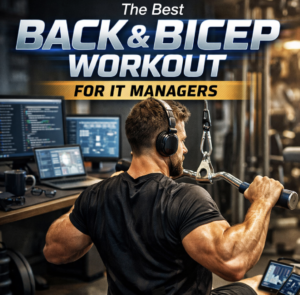
IT managers carry a different kind of load every day. You manage people, systems, vendors, priorities, deadlines, and the nonstop pressure of keeping everything running while technology keeps changing. A strong back and solid biceps are not just about looks in that kind of role. They help support posture, reduce the strain that comes from long hours at a desk, and build the kind of physical resilience that helps you stay sharp when the workday gets heavy.
This workout is built for IT managers who need something practical, efficient, and repeatable. It is designed to strengthen the muscles that support your shoulders, upper spine, and arms while also helping you undo some of the stiffness that comes from sitting, typing, and looking at screens. It is not a bodybuilding-only routine. It is a performance routine for leaders who need energy, consistency, and a body that feels better at the end of the day instead of worse.
Before the workout, it helps to remember what your job already demands. IT leadership today often includes budgeting, hiring, hybrid work, staff management, and process improvement, so your training plan needs to be simple enough to stick with even during busy weeks. CIO’s IT management coverage reflects how broad and demanding that role has become.
Why Back and Biceps Matter for IT Managers
A lot of IT managers spend long stretches sitting, leaning toward a monitor, and staying locked into the same posture while solving urgent problems. Over time, that can lead to rounded shoulders, upper-back tightness, and a weak posterior chain. When your upper back gets stronger, your posture improves. When your biceps and grip get stronger, everyday things feel easier too, from carrying equipment to moving boxes, climbing stairs with gear, or just feeling more stable and athletic overall.
Training back and biceps together also makes sense because many pulling movements train both at once. Rows, pull-downs, and pull-ups all work your back while your biceps assist. That means you get a lot of value in a shorter session, which is exactly what busy professionals need. This is a smart pairing when your calendar is packed and your energy needs to be managed well.
There is also a mental side to this. IT work can be reactive. A good workout gives you a block of time where you are not putting out fires. You are building something instead. That matters more than most people realize. It helps you reset your mind, improve focus, and come back to your team with more patience and more energy. 🔥
The Best Training Structure for a Busy IT Schedule
The best back and bicep workout is the one you can repeat consistently. For most IT managers, that means a focused session that takes about 45 to 60 minutes, done one or two times per week. If you are training four days a week, one dedicated back-and-biceps day works great. If you train three days a week, you can still use this workout as one of your core sessions.
This routine uses a simple structure:
Start with a short warm-up to open the shoulders and upper back.
Move into your biggest compound pulling exercises first.
Add targeted back work for thickness and posture.
Finish with bicep work for strength and arm development.
End with a brief cooldown to reduce tightness.
That order helps you get the hardest and most important lifts done while you are fresh. It also helps keep your form clean, which matters a lot when you spend most of your day already in fixed positions.
Warm-Up That Fixes Desk-Body Stiffness
Do not skip this part. A good warm-up can make the difference between a great training session and a stiff, frustrating one.
Spend 5 to 8 minutes on the following:
Arm circles, forward and backward, 30 seconds each
Band pull-aparts, 2 sets of 15
Cat-cow or thoracic spine mobility, 1 minute
Scapular wall slides, 2 sets of 10
Light dumbbell rows, 1 set of 15 each side
This warm-up opens the chest, activates the upper back, and gets your shoulder blades moving the way they should. That is huge for anyone who spends the day at a keyboard. You want your body to feel awake before you start loading it.
The Core Back and Bicep Workout
This is the main routine. Stick with this for 8 to 12 weeks before changing too much.
-
Lat Pulldown or Assisted Pull-Up – 4 sets of 8 to 12 reps
This is your vertical pull. It trains your lats, upper back, and biceps while helping build shoulder stability. Use a controlled tempo. Pull the bar toward your upper chest and avoid jerking with your lower back. If you can do pull-ups, use them. If not, lat pulldowns are excellent. -
One-Arm Dumbbell Row – 4 sets of 8 to 10 reps per side
This is one of the best exercises for IT managers because it builds strength while letting you focus on posture and control. Keep your spine neutral, pull your elbow back toward your hip, and pause at the top for a second. This teaches your upper back to work instead of letting your shoulders roll forward. -
Seated Cable Row – 3 sets of 10 to 12 reps
This movement helps build mid-back thickness and reinforces better posture. Sit tall, keep your chest up, and squeeze your shoulder blades together at the end of each rep. Do not lean too far back. The goal is tension, not momentum. -
Face Pulls – 3 sets of 12 to 15 reps
This is a gold exercise for people who live on laptops and monitors. Face pulls target the rear delts, traps, and upper back muscles that support healthy shoulder position. Pull toward your face, keep elbows high, and pause briefly. This one is not about ego weight. It is about quality. -
Straight-Arm Pulldown or Machine Pullover – 3 sets of 12 reps
This is a great isolation move for the lats and it helps reinforce the mind-muscle connection. Keep your arms mostly straight, move from the shoulders, and feel the sides of your back working. This exercise balances out the heavier row work and helps with back definition. -
Dumbbell Hammer Curls – 3 sets of 10 to 12 reps
Hammer curls build the biceps and brachialis while helping forearm and grip strength. That matters for real-world strength and long-term elbow comfort. Keep your wrists neutral and avoid swinging. -
EZ-Bar Curls or Dumbbell Supinating Curls – 3 sets of 8 to 10 reps
This is your heavier bicep strength movement. Control the lowering phase and keep your elbows close to your body. Good form beats heavy cheating reps every time. -
Cable Curls or Incline Dumbbell Curls – 2 to 3 sets of 12 to 15 reps
Finish with a controlled pump set. Higher reps here bring blood flow into the elbows and arms, which often feels great after a day of desk work. Slow reps and a full range of motion will give you better results than rushing.
That is the full session. It is balanced, effective, and made for sustainability.
How to Progress Without Burning Out
IT managers already deal with mental overload, so your workout should be challenging but not chaotic. Keep progress simple. Use one of these methods:
Add 1 to 2 reps before increasing weight
Add 5 pounds when all sets feel solid with good form
Slow down the lowering phase to increase control
Reduce rest time slightly for conditioning
You do not need to max out. You need to stack wins. Consistency beats intensity when you are balancing a leadership role, meetings, and after-hours issues.
A good target is to leave one or two reps in the tank on most sets. That keeps your joints happier and recovery smoother. You should finish the workout feeling worked, not destroyed. That is how you train hard and still show up strong the next day for your team.
Posture, Recovery, and the IT Manager Advantage
The workout is the spark. Recovery is where the results show up.
If you want this back-and-bicep routine to make a real difference, pair it with a few simple habits:
Stand up and move for 2 to 5 minutes every hour
Take short walking breaks between meetings
Keep your monitor height set so you are not constantly looking down
Do band pull-aparts or doorway chest stretches during the day
Sleep enough to recover and think clearly
These small moves help your training “stick” because they reduce the amount of stiffness you bring into every workout. IT managers who move a little throughout the day usually feel better lifting, recover better, and stay more consistent.
Nutrition matters too, but it does not need to be complicated. Focus on protein, hydration, and meals that support energy instead of big crashes. Your body and your brain both perform better that way. ⚙️
A Sample Weekly Split for IT Managers
If you want to plug this into a real week, this is a strong setup:
Monday: Back and Biceps
Tuesday: Walk or light cardio
Wednesday: Chest and Triceps
Thursday: Mobility or rest
Friday: Legs and Core
Saturday: Optional full-body or outdoor activity
Sunday: Rest
This gives you enough recovery while still building strength. If your week gets slammed with projects or outages, keep the back-and-bicep day. It gives you the most return for posture, upper-body strength, and stress relief.
IT News Sources Worth Following While You Build Strength
Since you wanted authority links related to IT news, these are strong sources to keep on your radar while you work on your health and leadership rhythm. They cover IT management, enterprise tech, industry shifts, and broader technology trends:
These are all useful for staying sharp on the trends that impact your role, from enterprise software and AI to security and leadership changes in the tech world. Reuters, CIO, and The Verge all maintain active technology coverage, and CIO specifically focuses on IT leadership topics that line up closely with the day-to-day realities of IT managers.
Conclusion
The best back and bicep workout for IT managers is not the flashiest one. It is the one that builds strength where you need it most, supports better posture, fits into a demanding schedule, and helps you feel better in your body while you lead in a high-pressure role.
This routine does exactly that. It strengthens your upper back, arms, and grip. It supports your shoulders after long hours at a screen. It gives you a repeatable structure you can rely on even during busy seasons. Most of all, it helps you build momentum in an area of life that makes everything else stronger too.
A strong back changes the way you carry yourself. Strong arms support the work you do every day. Consistent training gives you more energy, more confidence, and a better foundation for the long run.
That is a win in the gym and in IT leadership. 🚀